

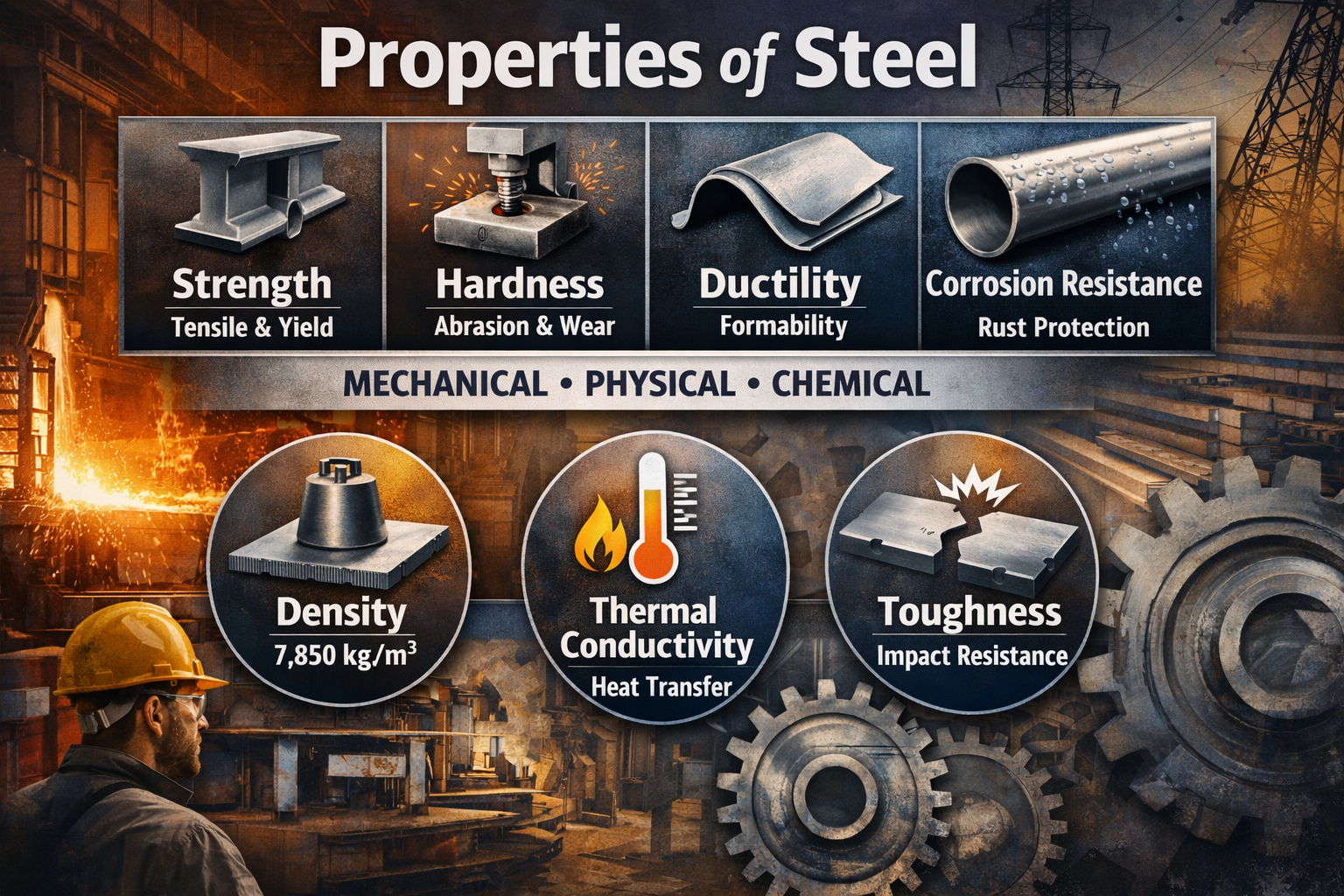
Steel remains the backbone of modern construction, manufacturing, energy, transportation, and infrastructure. For buyers, engineers, and fabricators, understanding the properties of steel is essential for selecting the right material for performance, safety, and cost efficiency. Understand the key mechanical, physical, and chemical properties of steel.
What Is Steel?
Steel is an alloy primarily composed of iron and carbon, with small amounts of other elements such as manganese, chromium, nickel, or molybdenum. By adjusting composition and processing, mills produce thousands of steel grades tailored to specific applications. The steel properties and steel grades vary among carbon steel, alloy steel and others. Steel material properties are important depending on use.
Key Mechanical Properties of Steel
Mechanical properties determine how steel behaves under load — critical for structural and industrial applications.
1. Strength (Tensile & Yield Strength) 💪
Strength is steel's ability to withstand forces without failure.
-
Yield strength: Stress at which steel begins permanent deformation
-
Tensile strength: Maximum stress before fracture
-
High-strength steels enable lighter designs without sacrificing performance
Applications: structural beams, heavy equipment, bridges, pressure vessels
2. Hardness 🔧
Hardness measures resistance to indentation, abrasion, and wear.
-
Higher carbon content typically increases hardness
-
Heat treatment can dramatically alter hardness levels
-
Essential for tools, dies, and wear plates
3. Ductility 🧰
Ductility is the ability to deform without breaking, allowing steel to be bent, rolled, or drawn into shapes.
-
Important for forming operations
-
Enables fabrication without cracking
-
High ductility improves seismic performance in structures
4. Toughness 🛡️
Toughness combines strength and ductility — the ability to absorb energy before fracturing.
-
Critical for impact resistance
-
Maintains performance in dynamic or shock loading
-
Essential for heavy machinery and transportation components
Physical Properties of Steel
Physical properties influence behavior under environmental conditions.
5. Density ⚖️
Steel has a density of approximately 490 lb/ft³ (7,850 kg/m³).
-
Provides mass and stability
-
Important for load calculations
-
Heavier than aluminum but stronger per unit volume
6. Thermal Conductivity 🔥
Steel conducts heat moderately well.
-
Important for high-temperature applications
-
Affects welding and thermal expansion
-
Influences performance in energy systems
7. Electrical Conductivity ⚡
Steel conducts electricity but far less efficiently than copper or aluminum.
-
Used where structural strength is also required
-
Relevant in grounding systems and industrial equipment
Chemical Properties of Steel
8. Corrosion Resistance 🌧️
Standard carbon steel will rust when exposed to moisture and oxygen. Corrosion resistance varies widely by grade.
-
Stainless steel: Contains chromium for rust resistance
-
Galvanized steel: Zinc coating protects base metal
-
Weathering steel: Forms protective oxide layer
9. Alloying Capability 🧪
Steel's greatest advantage is its adaptability through alloying.
Common alloying elements include:
-
Chromium → corrosion resistance & hardness
-
Nickel → toughness & low-temperature performance
-
Molybdenum → strength at high temperatures
-
Vanadium → grain refinement & wear resistance
Why Steel Properties Matter for Buyers
Selecting the wrong steel grade can increase costs, reduce lifespan, or compromise safety. Steel suppliers help customers match properties to application requirements, including:
-
Load-bearing capacity
-
Environmental exposure
-
Fabrication method
-
Service temperature
-
Regulatory standards
| Application | Critical Properties |
|---|---|
| Construction |
Strength, ductility, toughness |
| Manufacturing |
Hardness, machinability |
| Energy & Oil |
Corrosion resistance, toughness |
| Transportation |
Strength-to-weight ratio |
| Infrastructure |
Durability, fatigue resistance |
Steel's unmatched combination of strength, durability, formability, and cost effectiveness explains why it remains the world's most widely used engineering material. Understanding the core properties of steel allows buyers and engineers to optimize performance, safety, and lifecycle value across virtually every industry. 🌎
If you need help selecting the right steel grade, a knowledgeable supplier like ECONSTEEL can recommend materials tailored to your specifications, ensuring you get the best balance of performance and price.